
9 Plants You Can’t Kill (Even If You’ve Killed a Cactus Before)
As an Amazon Associate, CozyRoot earns from qualifying purchases. Rooty only recommends things he’d put in his own pot.
Hi, I’m Rooty! If you have ever whispered “sorry” to a crispy little plant in the trash, this guide is for you. Good news: there really are plants you can’t kill, or at least plants that are seriously hard to kill. They forgive missed waterings, dim corners, chilly windowsills and busy weeks. I was once a tiny sprout with zero confidence, and look at me now.
Below are my 9 favorite hard-to-kill houseplants, a quick comparison table, and the 3 habits that keep even “plant killers” winning.
Quick answer: The easiest plants to keep alive are the snake plant, ZZ plant, golden pothos, spider plant, cast iron plant, jade plant, Chinese evergreen, peperomia and aloe-style succulents. They tolerate low or uneven light, store water in their leaves or roots, and would rather be ignored than overwatered.
What Makes a Plant “Hard to Kill”?
Most “unkillable” plants share a few superpowers:
- They store water. Thick leaves, stems or underground rhizomes act like little water tanks, so a forgotten week is no big deal.
- They handle lower light. They won’t sulk if they live a few feet from the window.
- They are pest-resistant. Tough, waxy leaves are less tempting to bugs.
- They prefer drying out. This is the big one. Most indoor plants die from too much water, not too little, so plants that like dry soil are naturally beginner-friendly.
If your past plants died from forgetfulness, pick a water-storer. If they died from overwatering, pick one that loves drying out (spoiler: same plants).

The 9 Plants You Can’t Kill (Rooty-Tested)
1. Snake Plant (Sansevieria / Dracaena trifasciata)
Tall, calm and totally unbothered. The snake plant is happiest in bright, indirect light but tolerates low light too, which makes it perfect for bedrooms and hallways. Water only when the soil is completely dry, usually every 2 to 3 weeks, and even less in winter.
Rooty says: This one is the introvert of plants. It loves quiet, space and being left alone.
2. ZZ Plant (Zamioculcas zamiifolia)
Glossy leaves and chunky underground rhizomes that store water like a camel. If you travel a lot, the ZZ plant is your bestie. Give it low to medium indirect light and water when the soil is bone dry.
3. Golden Pothos (Epipremnum aureum)
Trailing vines, heart-shaped leaves and the easiest plant to propagate in the whole plant universe. Hang it, shelf it, or let it tumble down a bookcase. It grows in low to bright indirect light and tells you it’s thirsty by drooping a little. A drink perks it right back up.
Rooty says: Cut a piece, pop it in water, and boom, a new plant baby. Here is my full propagation guide.
4. Spider Plant (Chlorophytum comosum)
Curly leaves, dangling babies, and it’s pet-friendly too. Spider plants like bright, indirect light and evenly moist (not soggy) soil. Brown leaf tips usually mean dry air or chemicals in tap water, not a dying plant.
5. Cast Iron Plant (Aspidistra elatior)
The name says it all. Dark, dim corner? Chilly entryway? The cast iron plant shrugs. It grows slowly, so be patient and don’t overwater.
6. Jade Plant (Crassula ovata)
A tiny tree with plump, shiny leaves. Jade loves a sunny windowsill and dry soil between drinks. It’s a succulent, so it would rather be thirsty than soggy.
7. Chinese Evergreen (Aglaonema)
Colorful leaves in green, silver, pink and red that look fancy but act tough. It handles low to medium light and average room humidity like a champ.
8. Peperomia
Small, chunky leaves that fit on any desk. Many peperomias store water in their leaves, so they forgive missed waterings. Also listed as non-toxic to pets.
9. Aloe and Other Easy Succulents
If you have a bright, sunny window, aloe vera and haworthia are close to unkillable. The only way to lose them is drowning them, so water deeply, then wait until the soil is fully dry.
Hard-to-Kill Houseplants Compared
| Plant | Light | Water when… | Pet-safe? | Best for |
|---|---|---|---|---|
| Snake plant | Low to bright indirect | Soil fully dry (2-3 weeks) | No | Bedrooms, forgetful owners |
| ZZ plant | Low to medium | Soil fully dry (2-3 weeks) | No | Offices, travelers |
| Golden pothos | Low to bright indirect | Top 2 in. dry | No | Shelves, hanging baskets |
| Spider plant | Medium to bright indirect | Top 1 in. dry | Yes | Pet homes, hanging pots |
| Cast iron plant | Low | Top half dry | Yes | Dark corners |
| Jade plant | Bright, some sun | Soil fully dry | No | Sunny windowsills |
| Chinese evergreen | Low to medium | Top 2 in. dry | No | Colorful low-light spots |
| Peperomia | Medium to bright indirect | Top half dry | Yes | Desks, small shelves |
| Aloe / haworthia | Bright, some sun | Soil fully dry | Haworthia yes, aloe no | Sunny windowsills |
Pet safety is based on the ASPCA toxic and non-toxic plant list. If you share your home with a cat or dog, see my full list of pet-friendly plants.
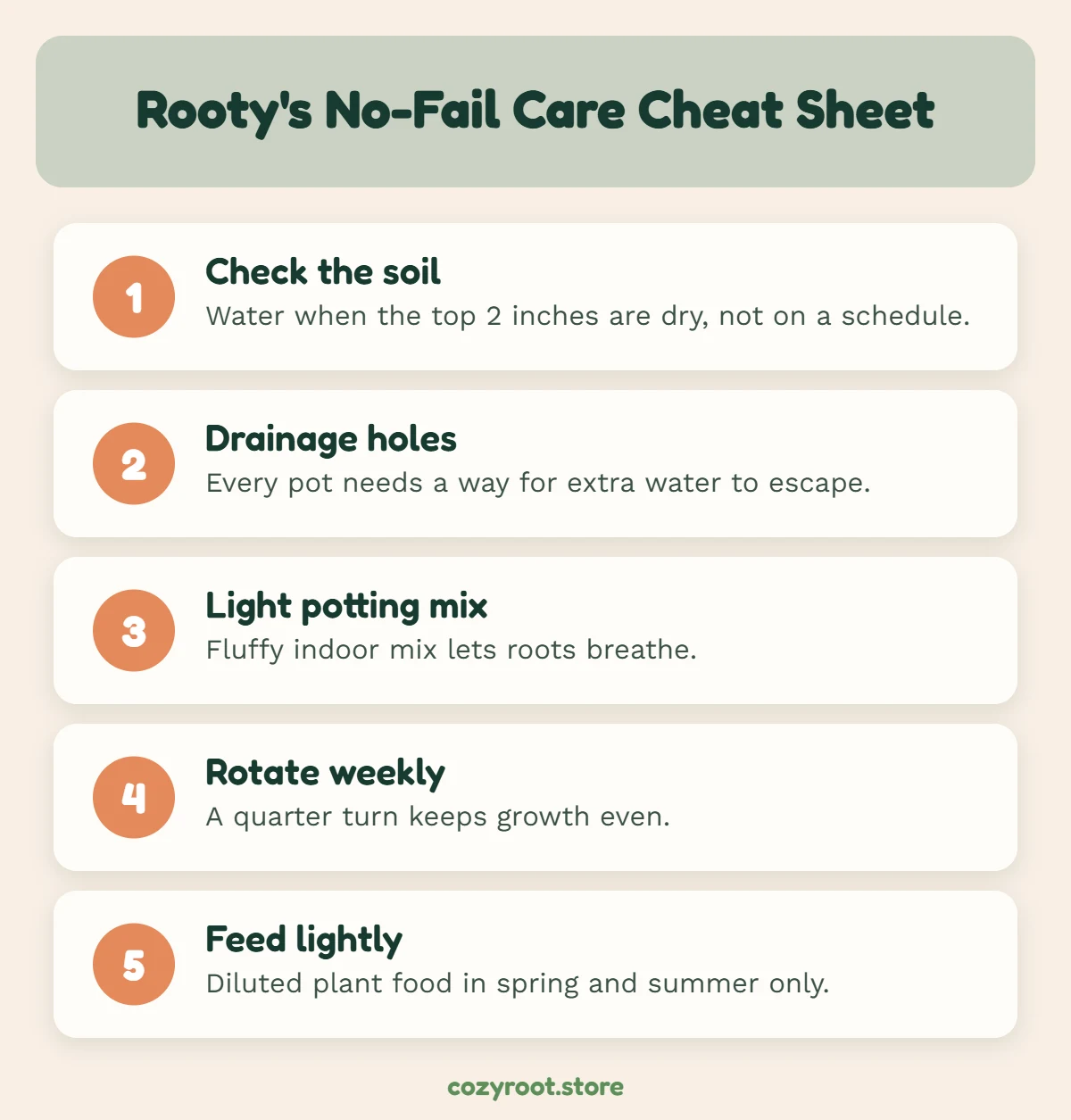
Rooty’s No-Fail Care Cheat Sheet
Even plants you can’t kill need three basics. Get these right and you’re 90% of the way there:
- Check the soil, not the calendar. Push a finger 2 inches into the soil. Dry? Water. Damp? Wait. A soil moisture meter takes the guesswork out completely.
- Always use a pot with drainage holes. Water that can’t escape rots roots. Rooty-approved ceramic pots with drainage solve this in one step.
- Use a light indoor potting mix. Heavy garden soil stays soggy. A fluffy indoor potting mix lets roots breathe.
Bonus habits: rotate your plant a quarter turn every week so it grows evenly, wipe dusty leaves so they catch more light, and feed with a diluted liquid plant food in spring and summer only.
Which Easy Plant Should YOU Get?
- Always forget to water? ZZ plant or snake plant.
- Dark apartment? Cast iron plant, ZZ or pothos. More ideas in my low light indoor plants guide.
- Curious cat or dog? Spider plant, peperomia or cast iron plant.
- Sunny window? Jade, aloe or haworthia.
- Want fast, happy growth? Golden pothos, every time.
Still not sure? Take my 30-second Find Your Plant Quiz and I’ll match you with your perfect plant personality plus a simple care routine.
Shop This Article
Here’s the tiny toolkit that keeps hard-to-kill plants unkillable:
- Soil moisture meter: stop guessing when to water. See Rooty’s watering picks
- Indoor potting mix: light, airy and made for containers. See soil picks
- Ceramic pots with drainage: cute and practical. See pot picks
- Self-watering pots: the forgetful plant parent’s secret weapon. See self-watering pots

FAQ: Plants You Can’t Kill
What is the hardest houseplant to kill?
The ZZ plant and snake plant are usually ranked the hardest to kill. Both store water, tolerate low light, and only need water every few weeks.
What is the best plant for a total beginner?
Golden pothos or a snake plant. Pothos shows you clearly when it’s thirsty by drooping, and snake plants forgive almost every mistake except overwatering.
How often should I water hard-to-kill plants?
Check the soil, not the calendar. Most of these plants want the top 2 inches (or the whole pot, for succulents) to dry out first. In winter, they need even less.
Do I need plant food?
A little diluted liquid fertilizer every few weeks in spring and summer helps them grow, but it’s optional for slow growers like ZZ and cast iron plants. Skip it in winter.
Are hard-to-kill plants safe for pets?
Some are, some aren’t. Spider plants, peperomia and cast iron plants are listed as non-toxic to cats and dogs by the ASPCA, while snake plants, ZZ, pothos and jade are not.
Keep Growing With Rooty
You are not a plant killer. You’re a plant parent who just needed the right plant. Start with one from this list, learn its rhythm, and add a friend when you feel confident.
Next reads: Why do I keep killing my plants? and the beginner plant shopping list.
Not sure which plant is right for you? Answer a few fun questions and Rooty will match you with the perfect plant + care routine. Made for beginners, loved by plant parents.